


The construction sector faces major challenges. On the one hand, the goal is to build 900,000 homes by 2030 in the Netherlands, including the necessary amenities. On the other hand, there are targets to reduce primary abiotic resource use (-50% by 2030), lower CO₂ emissions (-55% by 2030), and halve nitrogen emissions (by 2030).
To guide the transition toward a more circular construction sector, the industry needs a shared long‑term perspective. As a first step toward such a perspective, we outline the impact that different circular strategies can have up to 2035. In doing so, we examine construction‑technical strategies, building‑stock strategies, and strategies related to the construction and building‑materials industries.
Significant CO₂ reduction is possible
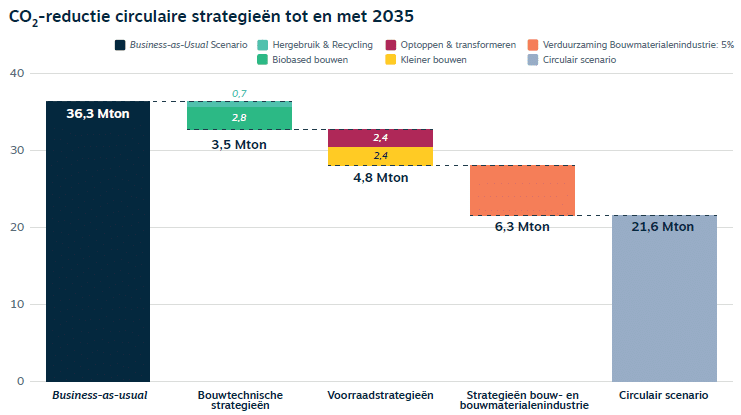
Construction‑technical circular strategies alone do not have enough impact to achieve the circularity goals. Reuse and recycling can deliver only limited savings up to 2035, both in CO₂ emissions (2.5%) and in primary material demand (5.5%). Bio‑based construction has greater potential, offering stronger reductions in both CO₂ emissions (9.5%) and primary material use (16.2%).
To meet climate and circular‑economy targets, however, circular strategies must also address the development of the building stock. Using the current goal of 900,000 homes by 2030 as a starting point, adding additional floors (optoppen) and transforming existing buildings can lead to significant savings in CO₂ emissions (8.4%) and primary material consumption (16.0%). The contribution of building smaller homes, which supports a more balanced housing stock, also contributes substantially to CO₂ reduction (8.1%) and to a decrease in primary material use (9.0%).
Finally, accelerated sustainability efforts within the construction‑materials industry are needed to achieve circularity goals. If the industry increases its annual CO₂ reduction rate from 2% to 5%, this would lead to an additional 11% CO₂ reduction by 2035.
With maximum effort across circular strategies combined with an accelerated sustainability transition within the construction‑materials industry, it is possible to reduce CO₂ emissions by 40% by 2035.
Building within planetary boundaries
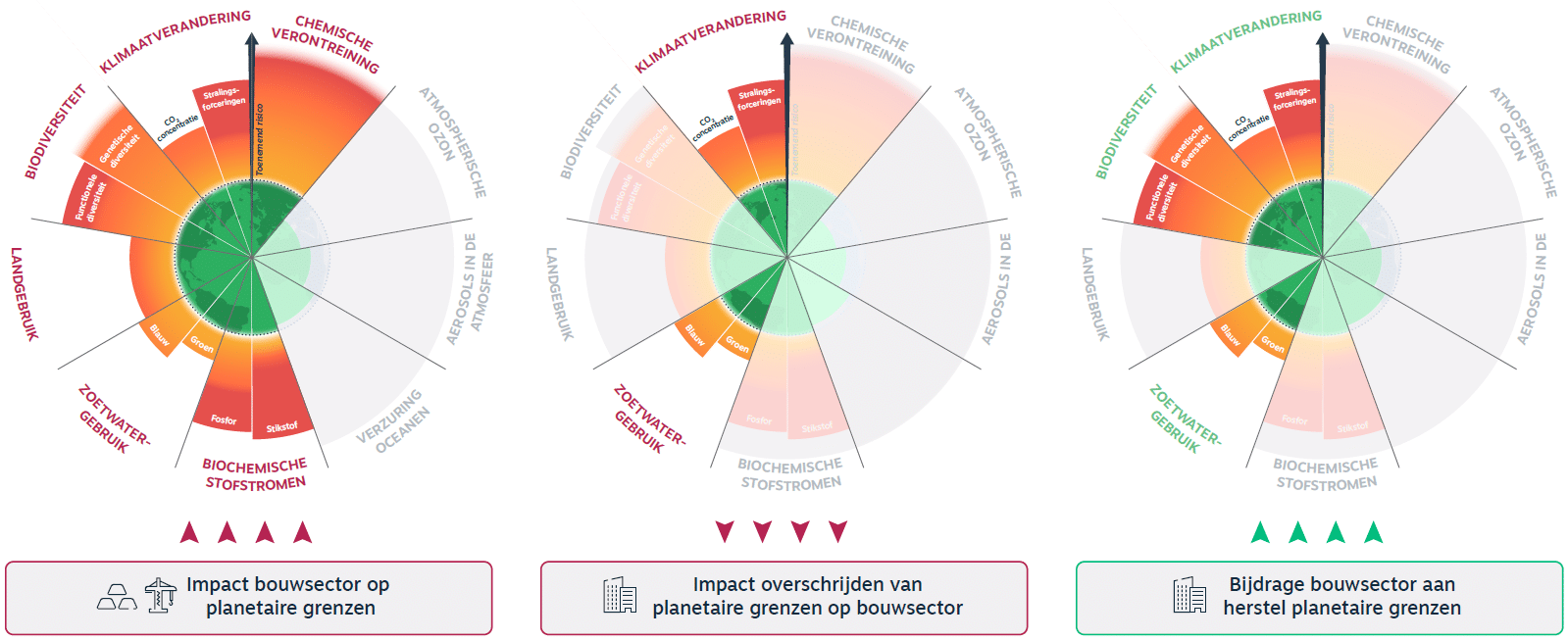
The sustainability challenges facing the construction sector are substantial: not only in terms of climate and biodiversity, but across multiple planetary boundaries. In a circular future, the construction sector contributes to a built environment that operates within these planetary boundaries. This means that construction minimizes its impact on climate change, chemical pollution, land use, and the disruption of the nitrogen cycle.
In addition, the construction sector takes a changing world into account: climate risks resulting from sea‑level rise and extreme weather are incorporated into planning and design. The sector also contributes to restoring boundaries that have already been exceeded, for example through CO₂ storage in (bio‑based) materials, retaining fresh water, and nature‑inclusive building.
*Please note this publication is only available in Dutch.