
Library
CO₂-impact of the Dutch Construction Sector
12 March 2024
CO2 impact van de Nederlandse bouw

The Netherlands faces a substantial construction task in housing, utility buildings, and infrastructure. In carrying out these tasks, there are high ambitions in the areas of climate and the circular economy. To prevent severe climate change, there is a maximum amount of CO₂ that may be emitted globally — and therefore also within the construction sector.
This so‑called “CO₂ budget” shows how large this maximum emission space is. If the Dutch construction sector wants to limit its contribution to global warming to 1.5 °C, the total remaining budget (from January ’23 onward) is 47 Mt CO₂. When limiting its contribution to 1.7 °C, this budget is 122 Mt, and when limiting its contribution to 2.0 °C, it is 234 Mt.
With the current way of building, these construction tasks result in a total CO₂ emission of 113 Mt up to and including 2030. Looking ahead to 2050, the total expected CO₂ emission is 297 Mt. The largest shares in this are the renovation of homes (44%), the replacement and renovation of infrastructure (20%), and the construction of new homes (15%).
The CO₂ budget for the entire Dutch construction sector for the 1.5 °C scenario will be exceeded in 2026 if building practices remain unchanged. If we accept a contribution from the Dutch construction sector corresponding to 1.7 °C of global warming, this budget will be exceeded in 2031. For a contribution of up to 2.0 °C, the limit will be reached in 2040.
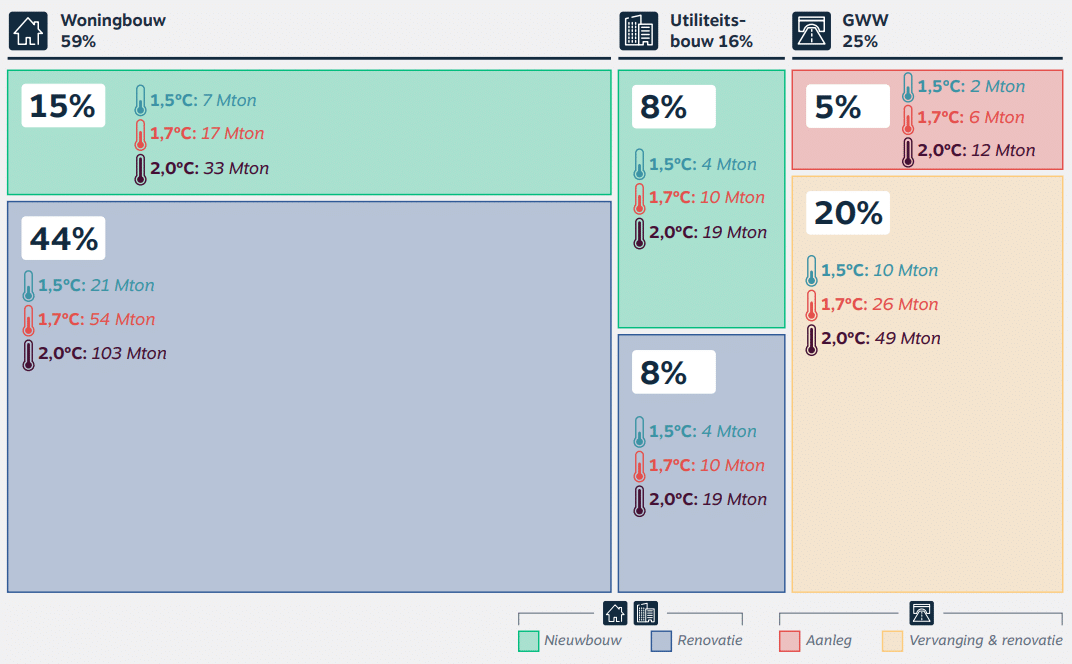
Distribution of the CO2-budget across subsectors of the construction industry
Focusing on circular strategies can reduce CO₂ emissions across the construction sector by 27% (30.4 Mt) up to 2030 compared to business-as-usual. The largest gains can be achieved in the renovation of homes (11.9%), the construction, replacement, and renovation of infrastructure (6.1%), and the construction of new homes (5.8%).
Among the various circular strategies, accelerated decarbonization of the construction materials industry provides the largest contribution, with a reduction of 7.9 Mt (7.0%). This is followed by building smaller (1.6 Mt / 1.4%) and biobased construction (1.4 Mt / 1.2%). In infrastructure, significant gains—1.1 Mt (1.0%)—can be achieved through the use of alternative materials.
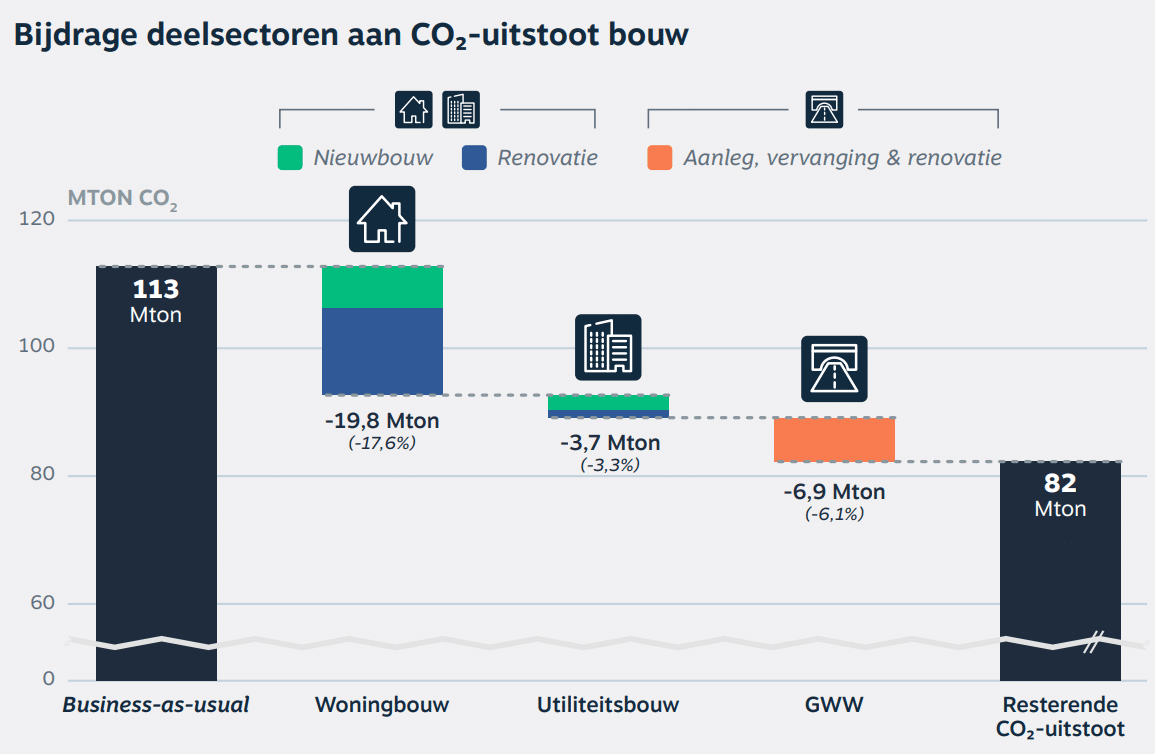
Contributions to CO2 reduction across different subsectors
Four key changes are required to reduce CO₂ emissions in the short term:
*Please note that this publication is only available in Dutch.