
Library
Residential Housing within Planetary Boundaries
20 April 2023
Woningbouw binnen planetaire grenzen

The construction sector is an industry with major impacts, where the tensions between significant societal challenges are strongly felt. On the one hand, the Netherlands has a target of building 100,000 homes per year to reduce the housing shortage and provide a pleasant living environment for all. On the other hand, there are ambitious targets for 2030 relating to climate (55–60% CO₂ reduction), the circular economy (50% reduction in material‑related environmental impact), and nitrogen (50% reduction in nitrogen emissions).
This exploration shows the material demand, CO₂ emissions, and environmental impact of the housing construction challenge through 2030. It assesses the impact of building according to a business‑as‑usual scenario and outlines six circular strategies to reduce that impact. The combination of these strategies results in a transition scenario that explores the extent to which we can meet current housing needs within the limits of our planet.
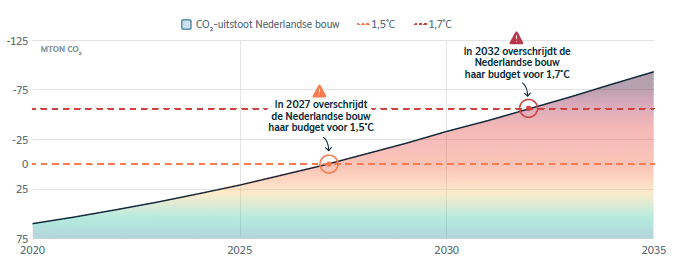
To limit global warming to 1.5°C, there is a maximum amount of CO₂ that can still be emitted worldwide: our CO₂ budget. This maximum emission level is a boundary condition needed to keep our world healthy, safe, and liveable for ourselves and future generations. With our current way of building, the ‘CO₂ budget for Dutch construction’ will be exceeded in 2027. Additional new construction is therefore not currently aligned with a 1.5°C scenario.
In a business‑as‑usual scenario, the material demand and environmental impact of construction continue to grow due to increased building production. For the housing construction challenge, this results in a total material demand of 104 Mton. Reinforced concrete represents the largest share of this — both by mass (67%) and by CO₂ emissions (45%). Concrete is followed by mineral‑based materials such as bricks and ceramics, accounting for 9% of mass and 10% of CO₂ emissions. Based on broader environmental impact (MKI in production and construction phases), building installations also have a significant share of 15%.
There are several strategies for reducing material use, CO₂ emissions, and environmental impact in meeting housing needs. This exploration assesses the impact of six strategies through 2030:
*Please note that this publication is only available in Dutch.