
Library
Circular revenue models in construction
06 February 2020
Circulaire Verdienmodellen in de Bouw


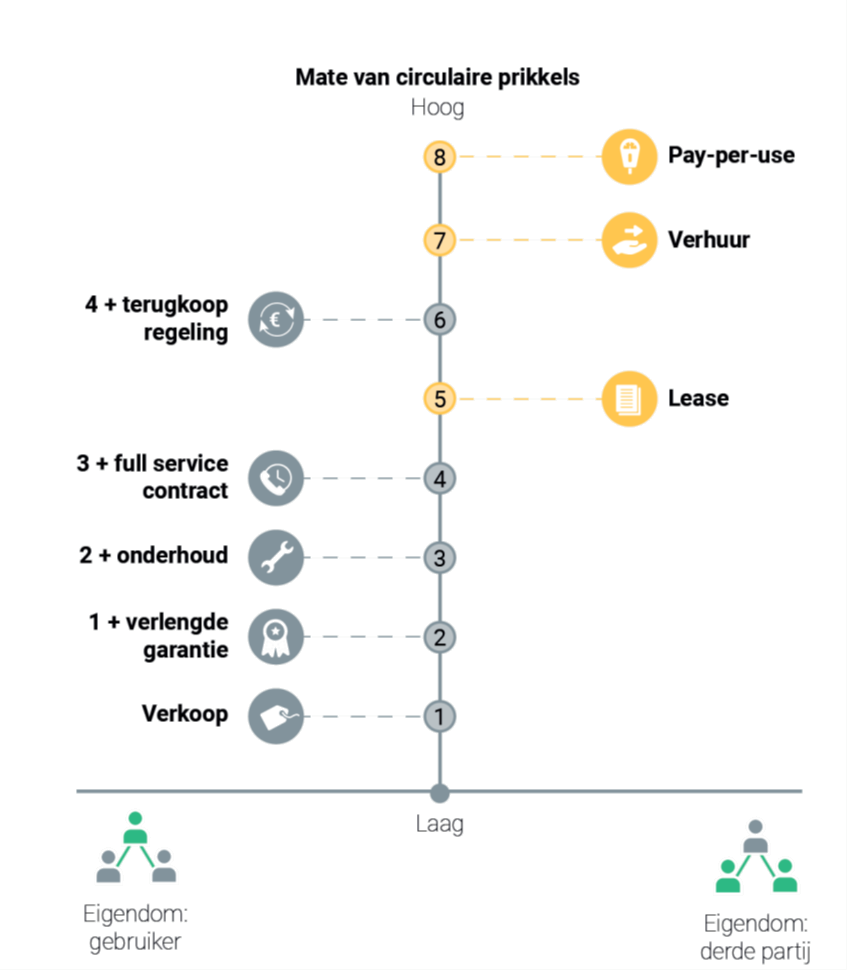
Circular business models such as leasing, renting, or pay‑per‑use are often mentioned as mechanisms to accelerate the transition toward a circular construction economy. Who isn’t familiar with Signify’s Pay‑per‑Lux concept? In recent years, more of these business models have entered the market: for example, Alkondor offered a façade under a leasing arrangement, and in the CIRCL pavilion, ABN AMRO partly pays for the horizontal and vertical movements delivered by the Mitsubishi elevator.
In business models such as leasing, renting, and pay‑per‑use, ownership remains with the producer; this gives form to ‘Extended Producer Responsibility’ (EPR). EPR is an important policy instrument emphasized by both the European Commission and the national government in the transition to a circular economy.
In 2018–2019, we conducted extensive research into circular business models, which resulted in a publication on the opportunities for entrepreneurs and a publication on the challenges for policymakers. In parallel, we also examined the construction sector: how does such a business model function when long lifespans are involved? And what happens when something is physically fixed to a building—does accession law then apply? Which business model is the ‘most’ circular, or does that depend on the layer of the building?
Our former intern Robbin Smeets spent nearly a year exploring this topic for his graduation research. His thesis has been summarised in the White Paper ‘Circular Business Models in Construction: Exploring Opportunities and Barriers’.
*Please note that the publication is only available in Dutch.