

Extended Producer Responsibility (EPR) plays an important role in both European and Dutch circular policy. The idea behind it is that when producers are made responsible for a larger part of the product lifecycle (including the use phase and end‑of‑life), they will start designing products for reuse, repair, and refurbishment. This reasoning aligns with the recommendations made by the Netherlands Environmental Assessment Agency (PBL) in the 2021 Integral Circular Economy Report.
Unfortunately, we see that current EPR systems are mainly focused on increasing and improving recycling. There is only one clear success story higher up the R‑ladder: the EPR system for beer bottles, which has existed for more than 30 years. Beyond that, there are hardly any examples at the higher R‑levels. Together with Rebel, we set out to find an explanation…
Before we can answer that question, it is important to clarify that there is no one‑size‑fits‑all solution for EPR. The design of an EPR system must be tailored to two important factors:
- The characteristics of the product group. Here we broadly distinguish between “simple” and short‑cycle products (left side of the matrix) and “complex” and long‑cycle products (right side of the matrix).
- The targeted R‑strategy. Here we distinguish between recycling and recovery (bottom of the matrix, >R8), and the high‑value strategies such as remanufacturing and reuse (top of the matrix, <R7).
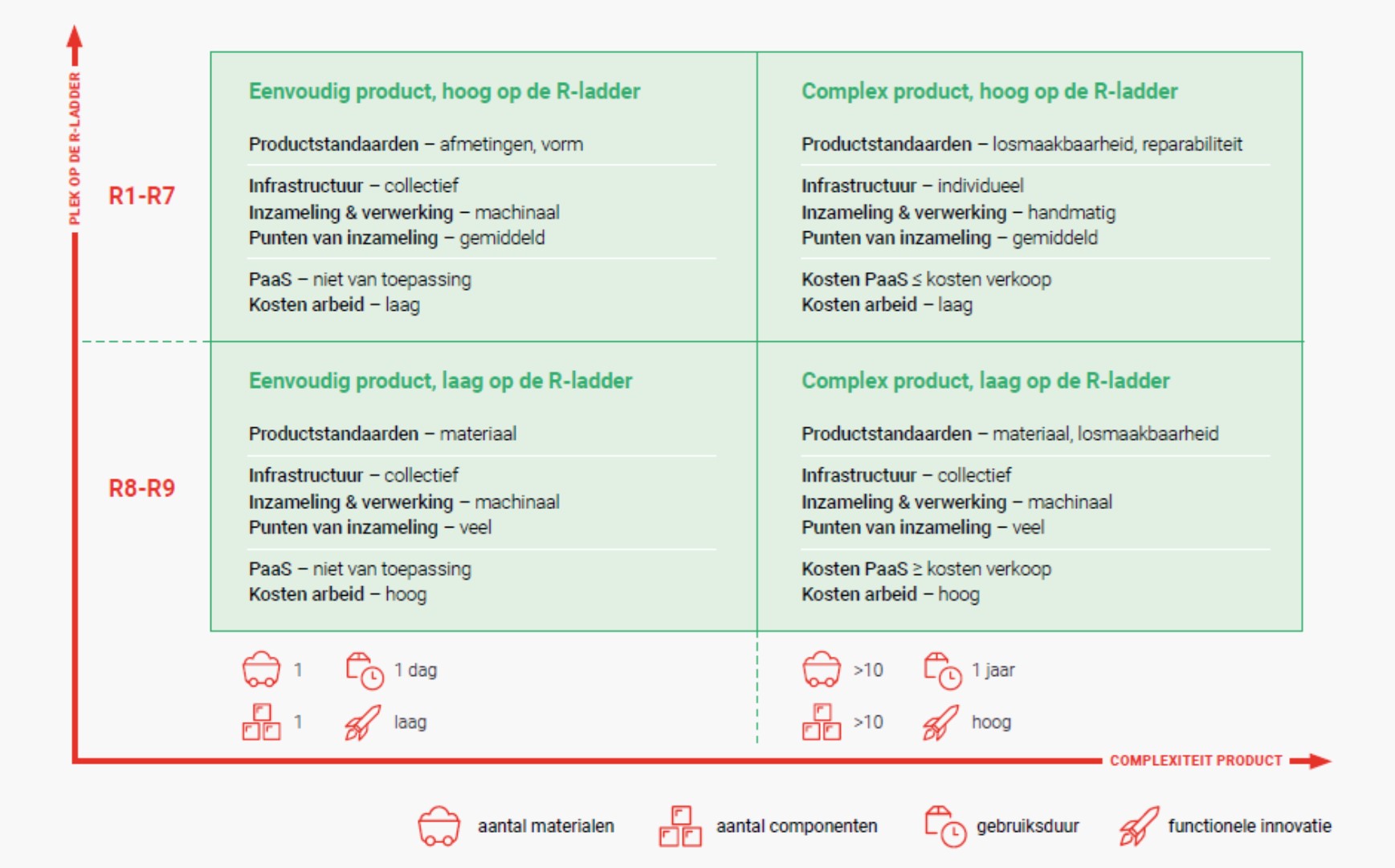
For EPR systems at a higher R‑level, the necessary enabling conditions are currently lacking. These conditions are particularly important for complex, long‑cycle products such as electronics, vehicles, and wind turbines. In light of current geopolitical developments, we must enable high‑value reuse of these products and their materials (often rare metals) as quickly as possible. This is achievable, provided the following conditions are met:
- Measuring circularity. Environmental impact assessments should pay greater attention to aspects that are specific to circularity, such as disassemblability and reparability.
- Fiscal incentives for circularity. Make labour cheaper and virgin raw materials more expensive, so that circular product design can pay off in later life cycles.
- Financial support for Product‑as‑a‑Service (PaaS) concepts. Develop a circular risk‑management model for financiers that incorporates not only the risks but also the opportunities of circular business models (such as higher quality and stronger control over material flows).
Our call to government, financiers, and market actors: ensure that these enabling conditions are put in place — and turn EPR into a success story!
*Please note that this publication is only available in Dutch.